Tips for Evaluating the Value of a Business Before Buying
Evaluating the value of a business before buying it is a critical step to ensure that you do not pay above the fair price and that the business is viable in the long term. This process involves the analysis of...

Contents
Evaluating the value of a business before buying it is one of the most critical steps in the entire process: it ensures that you do not pay above the fair price and that the business is viable in the long term. The evaluation combines numbers (the company's accounts) with qualitative factors (market, customers, owner dependency) and never results in a unique and absolute value — it results in a defensible range that supports your negotiation.
This guide explains, in a practical way, what to analyse and the main methods to arrive at that value. It does not replace the support of an accountant or M&A consultant: for financial and tax decisions, always validate with qualified professionals.
Start by Defining the Purpose of the Purchase
Before looking at numbers, clarify what you are looking for. Do you want to expand a business you already have, enter a new market, acquire a customer portfolio, or invest in a profitable company to manage? The purpose determines which factors weigh more in the evaluation — those buying for synergies value different aspects than those buying for immediate profitability — and helps decide how much it makes sense to pay.
Financial Analysis: The Basis of Any Evaluation
A serious evaluation starts with the accounts. They confirm whether the company is actually earning what it claims to earn and whether that result is sustainable.
Financial Statements
Examine the reports from the last three to five years — balance sheet, income statement, and cash flow. Look for consistency in profits, revenue growth, and expense control. Sharp fluctuations or atypical years should be explained.
Debt Levels
Check the company's debt level. High liabilities increase risk, especially if profits do not comfortably cover financial obligations. Distinguish between healthy debt (which finances growth) and debt that merely covers cash flow gaps.
Profit Margin
Analyse the margin and compare it with companies in the same sector. Margins consistently above average may indicate efficiency or a competitive advantage; shrinking margins are a signal to investigate.
To frame all this within the total budget of the operation, also see how much it costs to buy a business.
The Main Evaluation Methods
There is no single right method — professionals often cross-reference several and compare the results. These are the three most commonly used in small and medium-sized enterprises.
Market Multiples (Profit-Based Valuation)
This is the most common approach in SMEs. It involves applying a multiple to a measure of result — typically EBITDA or profit — based on what similar companies in the same sector are usually worth. Multiples like Price/Earnings (P/E) or Value/EBITDA provide a quick estimate of value relative to the sector. The appropriate multiple varies greatly with the activity, size, and risk of the business, so it should be supported by real sector references and validated by someone who knows the market.
Discounted Cash Flow (DCF)
The Discounted Cash Flow method calculates the present value of expected future cash flows, applying a discount rate that reflects risk. It is useful for companies with positive and predictable cash flow, but it is sensitive to assumptions: small changes in projections or rates can significantly alter the result. Use it with realistic, not optimistic, projections.
Asset-Based Valuation
Here, the value starts from net assets — assets minus liabilities. It makes sense in companies with many tangible assets (equipment, real estate, inventory) or in scenarios of cessation of activity. It tends to ignore the value of the business "in operation" (the brand, customer portfolio, history), so it should rarely be used in isolation for a profitable business.
Assets, Liabilities, and Growth Potential
Tangible and Intangible Assets
Tangible assets (equipment, real estate, inventory) should be properly valued and in usable condition. Intangible assets (brand, patents, reputation, customer portfolio) are harder to quantify but can represent a significant part of the value — especially in businesses with recurring customers.
Liabilities
Identify all debts and obligations, including those not visible (guarantees provided, tax or labour contingencies). Assess whether the company can honour them without compromising operations.
Growth Potential
Look at the market (growing, stagnating, or declining), the competition (does the company have any clear advantage?), and the ability to innovate and adapt. A well-positioned company in an expanding market justifies a higher value than the historical numbers alone suggest.
Due Diligence and Qualitative Factors
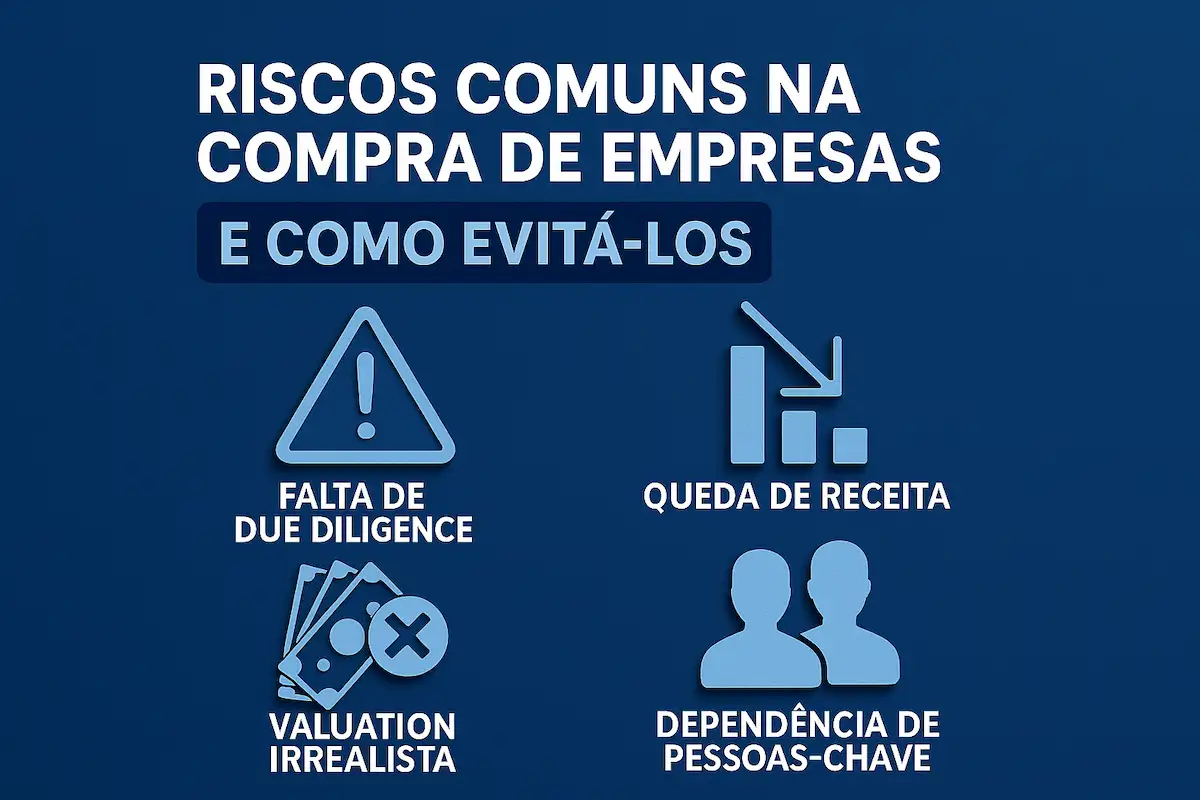
The financial evaluation must be validated on the ground through due diligence. Confirm legal compliance and the absence of relevant litigation, the relationship with customers and suppliers (pay attention to excessive dependency on one), and the culture and commitment of the team. Also, understand why the owner is selling: retirement or life change are normal; a sale motivated by business problems requires deeper investigation.
Errors to Avoid in Evaluation
Basing the value on a single method — always cross-reference at least two.
Relying solely on the numbers provided by the seller without validating them.
Ignoring hidden liabilities and contingencies.
Letting emotion or pressure from the seller guide the decision.
Forgetting the value of intangibles in a profitable business.
When to Seek Specialists
Engaging an accountant, a statutory auditor, or an M&A consultant often makes the difference between a good and a bad purchase. These professionals help validate the numbers, choose the right methods, and identify details that might go unnoticed. The cost of this support is usually much lower than paying too much for a business or inheriting an undetected liability.
Frequently Asked Questions About Business Valuation
How is the value of a business evaluated?
The value is evaluated by cross-referencing financial analysis (accounts from the last 3 to 5 years) with one or more valuation methods — market multiples, discounted cash flow (DCF), and asset-based valuation — and adjusting the result with qualitative factors such as the market, customer portfolio, and dependency on the current owner. The goal is to arrive at a defensible value range, not a single number.
What is profit-based valuation?
It is the multiples approach: a multiple is applied to a measure of result (usually EBITDA or profit), referencing what similar companies in the same sector are usually worth. It is the most used method in small and medium-sized enterprises due to its simplicity, but the correct multiple depends greatly on the sector, size, and risk of the business.
How many years of accounts should I analyse?
As a general rule, the last three to five years. This period allows you to see trends (is revenue and profit growing, stable, or declining?) and identify atypical years that need explanation. Less than three years provides little perspective; more than five rarely adds much in an SME.
Is it worth paying for a professional valuation?
In most cases, yes. An independent valuation done by an accountant, statutory auditor, or M&A consultant provides a solid basis for negotiation and reduces the risk of overpaying or inheriting problems. The cost is usually a small fraction of the transaction value.
Next Step
After estimating the fair value, it is important to decide how to finance the purchase of a business in Portugal. And if you already know what you are looking for, see the businesses for sale in Portugal.
Official sources and resources
- Company valuation tool — IAPMEI