Common Risks in Buying Businesses and How to Avoid Them
Buying a business can be an excellent investment opportunity, but it also presents significant risks that, if not properly assessed, can jeopardise the success of the business....
Contents
Buying a business can be a smart shortcut to enter the market - but it can also turn into a financial nightmare if you do not know where the pitfalls are. The truth is that many buyers, excited about the opportunity, end up ignoring warning signs that later prove costly.
In this article, we will go through the most frequent risks and, more importantly, how to protect yourself from each of them. We remind you that reading this article does not replace consulting legally qualified professionals to assist you in this process.
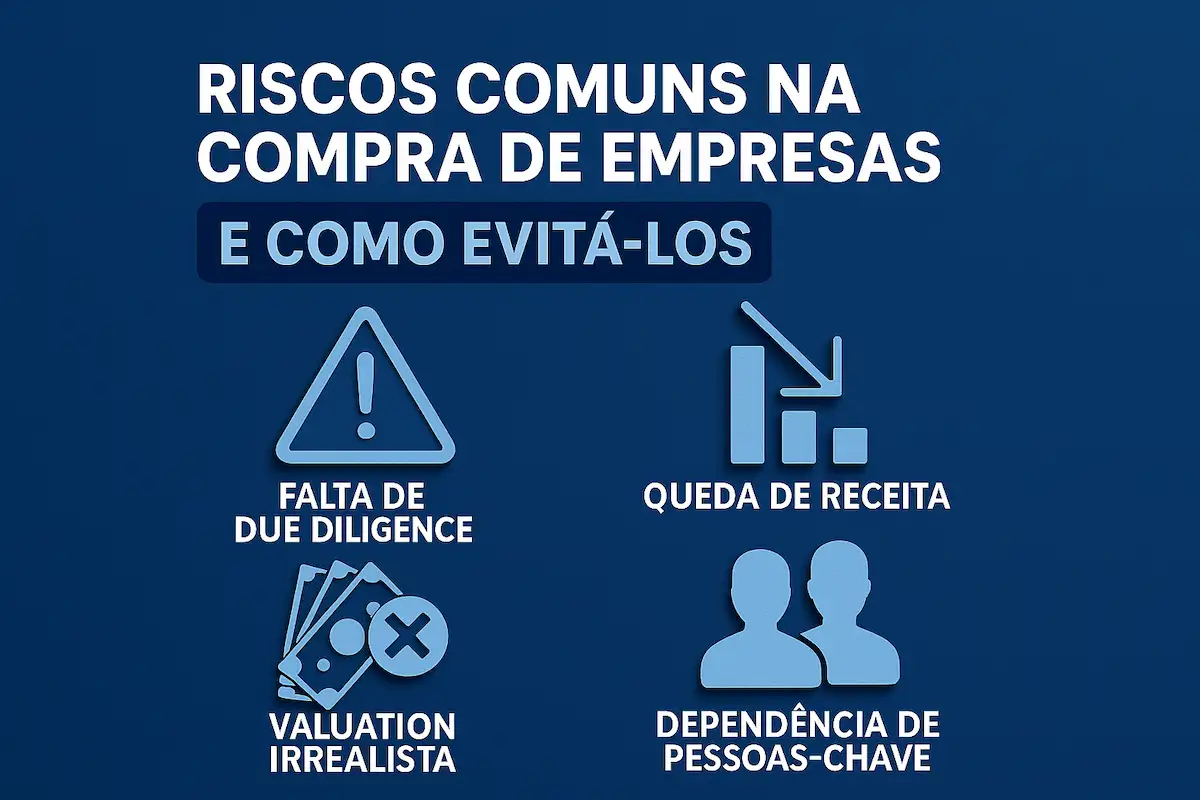
Poorly Conducted Due Diligence
This is probably the most common mistake - and the most avoidable. Due diligence is the detailed investigation you conduct before signing anything. When done hastily or superficially, unpleasant surprises appear later, when it is too late.
What to do to prevent this? Do not try to save money at this stage.
Involve a lawyer, an accountant, and, if necessary, specialised consultants in the sector. Ask to see everything: contracts with clients and suppliers, tax situation, litigation history, outstanding debts. If the seller hesitates to show documents, that is already a warning sign.
Also consider an independent audit - the investment pays off compared to the cost of discovering problems after the purchase.
To structure this step, use our due diligence checklist for buying a business.
Hidden Liabilities
Undeclared debts, ongoing lawsuits, environmental or tax issues - these are liabilities that may not surface but, legally, become yours after the acquisition.
The best protection is contractual. Insist on warranty clauses that require the seller to indemnify you for any undisclosed liabilities during the negotiation. Additionally, investigate the company's history with the Tax Authority and Social Security to confirm that there are no outstanding debts.
Also check if the company complies with all legal obligations - labour, environmental, licensing. A visit to the Online Permanent Certificate can reveal important information about the legal status of the company.
When the company already shows cash flow problems, recurring losses, or accumulated debts, the risk requires its own analysis. See our guide on buying distressed businesses before proceeding.
Paying More Than the Business is Worth
It is easy to get carried away by excitement or the seller's optimistic projections. The result? Paying an inflated price that you cannot recover later.
Before negotiating, hire a professional appraiser who uses multiple valuation methods - not just what the seller suggests. Look at financial projections with healthy skepticism and ask yourself: are these projections based on concrete data or generous assumptions?
Also compare with similar transactions in the market. If you are evaluating the purchase of a business, research how much has been paid for businesses of the same sector and size. The businesses listed on our platform can give you an idea of the values practiced.
Cultural Shocks in Integration
A frequently underestimated risk.
The company may have excellent numbers on paper, but if the organisational culture is incompatible with your management style, integration will be difficult - and the best employees may leave.
During due diligence, pay attention to the company's culture:
What is the work environment like? How are decisions made? What is the relationship between management and the team?
Prepare an integration plan before closing the deal. And, above all, communicate with employees from the start. Uncertainty generates anxiety, and anxiety generates turnover.
Excessive Dependence on Few Clients or Suppliers
If 60% of revenue comes from two clients, you are buying a concentrated risk. If one of them leaves, the business could collapse.
Analyse the client and supplier portfolio in detail. What percentage of revenue comes from the five largest clients? Are there long-term contracts or are the relationships informal?
If you identify a high dependency, negotiate the price accordingly - or require the seller to guarantee the continuity of those contracts for a period after the sale.
Underestimating Transition Costs
Many buyers focus on the acquisition price and forget everything else: integration of IT systems, team training, potential rebranding, operational adjustments. These costs can easily represent 10% to 20% of the transaction value.
Make a realistic budget of all post-acquisition costs before closing the deal. In some cases, you can negotiate for the seller to share some of these costs or offer a transition support period.
Buying Without a Clear Plan
Buying a business without knowing exactly what you will do with it is a recipe for disappointment. "It seemed like a good opportunity" is not a strategy.
Before proceeding, clearly define: why do you want this business? What will you do differently? How will you generate value? What are the goals for the first year?
Develop a concrete business plan, with short- and long-term objectives. And after the purchase, regularly monitor the results to ensure you are on the right track.
Always Remember!...
Buying a business involves real risks - but risks that can be managed with proper preparation. Rigorous due diligence, support from specialised professionals, and careful planning of each step make all the difference between a successful acquisition and an expensive mistake.
The secret is not to avoid all risks - that is impossible. It is to know them, quantify them, and consciously decide which ones you are willing to accept.
Ready to take the next step? Explore the available businesses or learn more about how to buy a business on the Comprar Empresa marketplace.
Official sources and resources
- Permanent commercial registration certificate — Justiça.gov.pt
- Tax debt clearance certificate — Autoridade Tributária e Aduaneira
- Social Security contribution status certificate — Segurança Social
- Central Register of Beneficial Ownership — Justiça.gov.pt