Buying Distressed Businesses: Real Opportunity or Risk of Inheriting Debts?

Contents
Every month, tempting advertisements appear: businesses for sale at symbolic prices, "open for business" operations needing a new owner, companies handed over for 1 euro. For an attentive buyer, a distressed business can represent a quick entry into a market, an already known brand, a customer base, or equipment at a fraction of the cost of starting from scratch. But there is a fine line between opportunity and trap — and that line is almost always called debt.
This guide explains, in practical terms, what it means to buy distressed businesses, why the price can be so low, the acquisition routes, and, above all, how to proceed without inheriting problems that are not yours. First and foremost, a note of caution: nothing replaces the analysis of the specific case by a lawyer and an accountant. This article is guidance, not legal advice.
What does "distressed business" or "for 1 euro" mean?
A distressed business is typically a company with cash flow problems, negative results, accumulated debts, or an ongoing insolvency process. These situations range from still viable businesses, but suffocated by lack of liquidity, to structures that are practically hollow, with more liabilities than assets.
And the famous price of 1 euro? It is rarely what it seems. When someone sells a company for a symbolic amount, what they are usually conveying is not a "gift" — it is a set of responsibilities. The buyer pays little for the shares but takes control of a company that may carry debts to suppliers, the bank, the Tax Authority, or Social Security. In other words: the real price is not the euro stated in the contract, but the sum of the liabilities that come with it.
This does not make the deal bad — it makes it a deal that must be evaluated to the penny. The right question is never "how much does it cost?", but rather "what do I inherit by buying this?".
Acquisition routes: where the risk of debts is decided

There is a critical difference between the ways to acquire a distressed business. This is where many buyers go wrong — and this is where money is made or lost.
Buying the company (shares or stocks)
Buying the shares means buying the business "as is". The legal entity remains the same; only the owner changes. This means that, in principle, the buyer assumes all the history of the company: contracts, processes, guarantees provided, and, of course, the debts — including those that have not yet appeared. It is the route with the highest risk of inheriting hidden liabilities and, therefore, the one that requires the deepest due diligence.
Buying only the assets
In an asset purchase, the buyer selects what they want — equipment, inventory, brand, customer base — leaving, in principle, the debts with the selling company. It is often the safest route for those who want the business without the past. However, caution is advised: there are relevant exceptions. The transfer of a business may involve the transfer of employment contracts and, in certain situations, some tax liabilities may accompany the buyer. These points must be confirmed on a case-by-case basis with legal support.
Business transfer
A business transfer is the transfer of an operating commercial establishment — the space, the contents, the clientele, and often the position in the lease contract. It is common in hospitality and retail. Here too, there are precautions: the landlord may have rights to safeguard, and employment contracts tend to follow the establishment. Never assume that "business transfer" means "without responsibilities".
Main risks (and how to mitigate them)
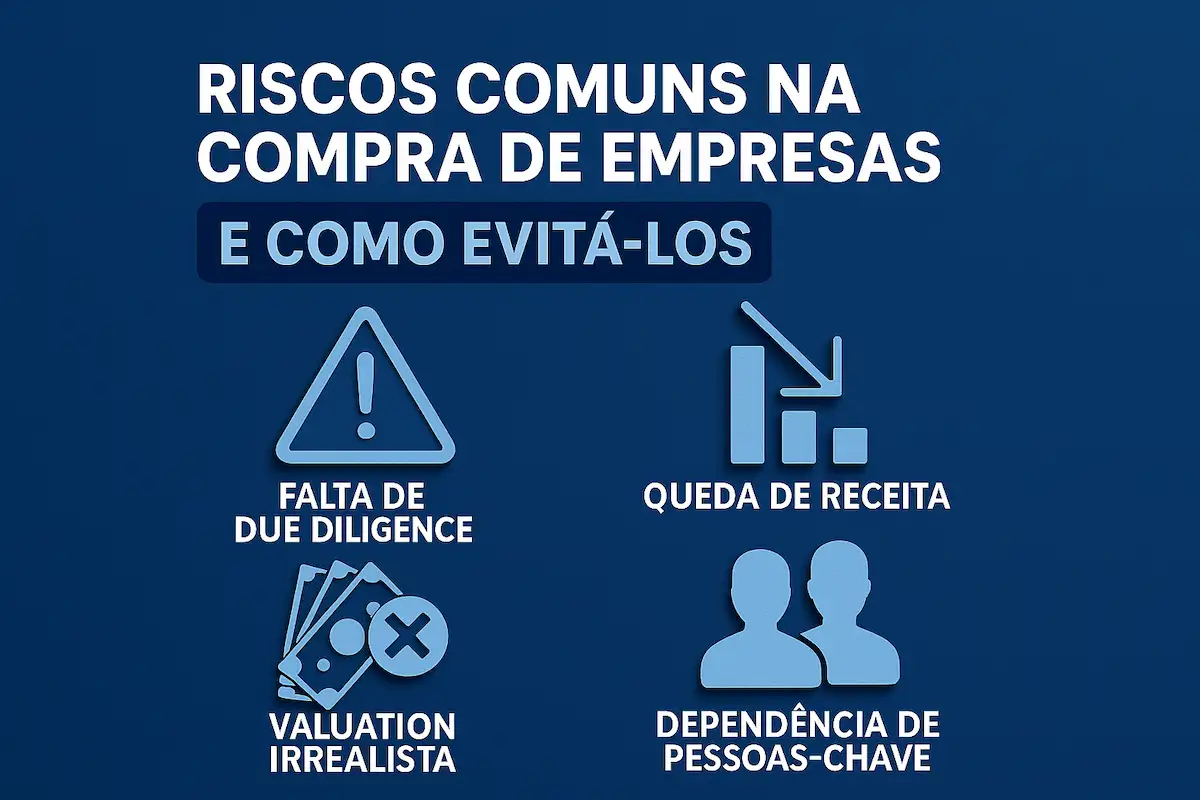
The biggest mistake in distressed businesses is falling in love with the price and ignoring what lies beneath. The most common risks are:
Hidden debts: unregistered liabilities, personal guarantees, endorsements, unpaid invoices, or ongoing litigation.
Tax and Social Security: tax and contribution debts, defaulted payment plans, liens. Always request certificates of regularised status.
Labour liabilities: overdue salaries, unpaid benefits, potential compensations, and contracts that may transfer to the buyer.
Contracts and suppliers: change of control clauses, rents, financial leases, contracts with deadlines or penalties.
Overvalued assets: obsolete equipment, unsold inventory, customers who disappear when ownership changes.
The tool that separates the informed buyer from the gambler is called due diligence: a financial, tax, legal, and labour audit before signing anything. Demand access to accounts, statements, certificates, contracts, and debt maps. Whenever possible, condition payment on the confirmation of information and negotiate contractual guarantees (seller statements, retention of part of the price, liability clauses for previous liabilities). To leave nothing out, follow a due diligence checklist for buying a business and learn in detail about the common risks in buying a business.
Practical steps to proceed safely
Define the investment thesis: what do you really want to buy — the brand, the customers, the space, the team? This determines the best route (assets, shares, or business transfer).
Request essential information: latest accounts, current balance sheets, certificates from the Tax Authority and Social Security, debt map, and list of contracts.
Conduct serious due diligence: ideally with an accountant and lawyer. This is where you discover what the seller does not disclose.
Evaluate and structure the deal: choose the route that minimises the risk of debts and set the price based on the real liabilities, not the symbolic value.
Protect yourself in the contract: promise contract, seller statements and guarantees, suspensive conditions, and, if applicable, retention of part of the price.
Only then, sign and pay.
If you want to understand the entire process from start to finish, see our guide on how to buy a business.
When it makes sense — and when to run away
It makes sense to proceed when the company's problem is identifiable and solvable: lack of management, poorly organised cash flow, a tired owner, a good business with bad finances. If the buyer brings capital, competence, or channels that the seller did not have, the potential for recovery is real.
You should run away when: the seller refuses to show accounts; there are tax debts or Social Security debts without a credible plan; there are personal guarantees and endorsements to clarify; the "1 euro" hides a liability that no one can quantify; or when the activity itself is in structural decline. When in doubt about the origin of the debts, the rule is simple: do not sign.
Conclusion
Buying a distressed business can be one of the best business decisions — or one of the worst. The difference is not in courage, but in information and the legal structure of the deal. A symbolic price is never a reason to let your guard down; it is a reason to investigate with double the rigor. Conduct your due diligence, surround yourself with a trusted lawyer and accountant, and treat every euro of liability as what it is: real money.
If you are exploring opportunities, see the businesses for sale and start analysing each case methodically before falling in love with the price.
Frequently asked questions
Buying a business for 1 euro means I don't pay anything else?
No. The symbolic value usually refers to the shares. By buying the company, you become responsible for its liabilities — debts to banks, suppliers, the Tax Authority, and Social Security. The "real cost" is the set of responsibilities you inherit.
Do I inherit debts if I buy a distressed business?
It depends on the route. By buying the shares, you generally assume the history and debts of the company. By buying only assets, you tend to leave the liabilities with the seller — with exceptions, especially labour and tax-related. Always confirm the structure with a lawyer.
How do you buy businesses in insolvency?
Insolvent businesses have their assets managed within a process, often with the sale of assets or the activity conducted by an insolvency administrator under judicial supervision. It can be a route to acquire assets with less "history" attached, but requires specialised oversight.
Is it worth buying a failed business?
It can be worth it if the problem is management or cash flow and not the business itself, and if you can structure the purchase to avoid inheriting the liabilities. It is almost never worth it when the activity is in structural decline or when it is impossible to quantify the debts.
What is essential to check before buying?
At a minimum: certificates of regularised status with the Tax Authority and Social Security, updated accounts and balance sheets, debt maps, active contracts, guarantees and endorsements provided, and the labour situation. All of this is part of due diligence.
Official sources and resources
- Insolvency and Business Recovery Code — Diário da República
- Permanent commercial registration certificate — Justiça.gov.pt
- Tax debt clearance certificate — Autoridade Tributária e Aduaneira
Next step
Move from research to real opportunities
Browse available businesses and apply what you have just learned to the opportunities that fit your goals.