Due Diligence in Buying a Business: Complete Checklist
Due diligence is essential before buying a business, assessing risks, confirming information, and identifying hidden liabilities to negotiate a fair price.

Contents
Due diligence is the financial, legal, and operational investigation conducted before buying a business. It serves to confirm whether the numbers, contracts, assets, and liabilities correspond to what has been presented and to decide whether to proceed, renegotiate, or withdraw. The scope depends on the size and risk of the transaction; validation with an accountant and lawyer is usually prudent.
Buying a business without rigorous due diligence is like buying a house without visiting it: it may seem like a good deal from a distance and hide costly problems underneath. Due diligence is the investigative process that confirms whether what the seller says corresponds to reality — and it is your main protection against hidden liabilities, undeclared debts, and surprises after the deed.
This is a practical checklist, organised by areas, to guide you before signing. Use it as a starting point and adapt it to the size and sector of the business. For tax, legal, or accounting decisions, always validate with qualified professionals.
What is due diligence (in summary)
It is the audit that the buyer conducts on the business before the purchase, to assess its financial, legal, tax, and operational health. It serves three purposes: identify risks, validate the seller’s information, and underpin the negotiation of the price and conditions.
In practice, due diligence functions as a structured investigation: the buyer (supported by an accountant and lawyer) requests access to documents, cross-references them with the reality of the business, and transforms what they discover into decisions — to proceed, renegotiate, or withdraw. The more organised the information the seller provides, the faster and cheaper the process; the lack of documentation is, in itself, a warning sign.
Due diligence checklist by area
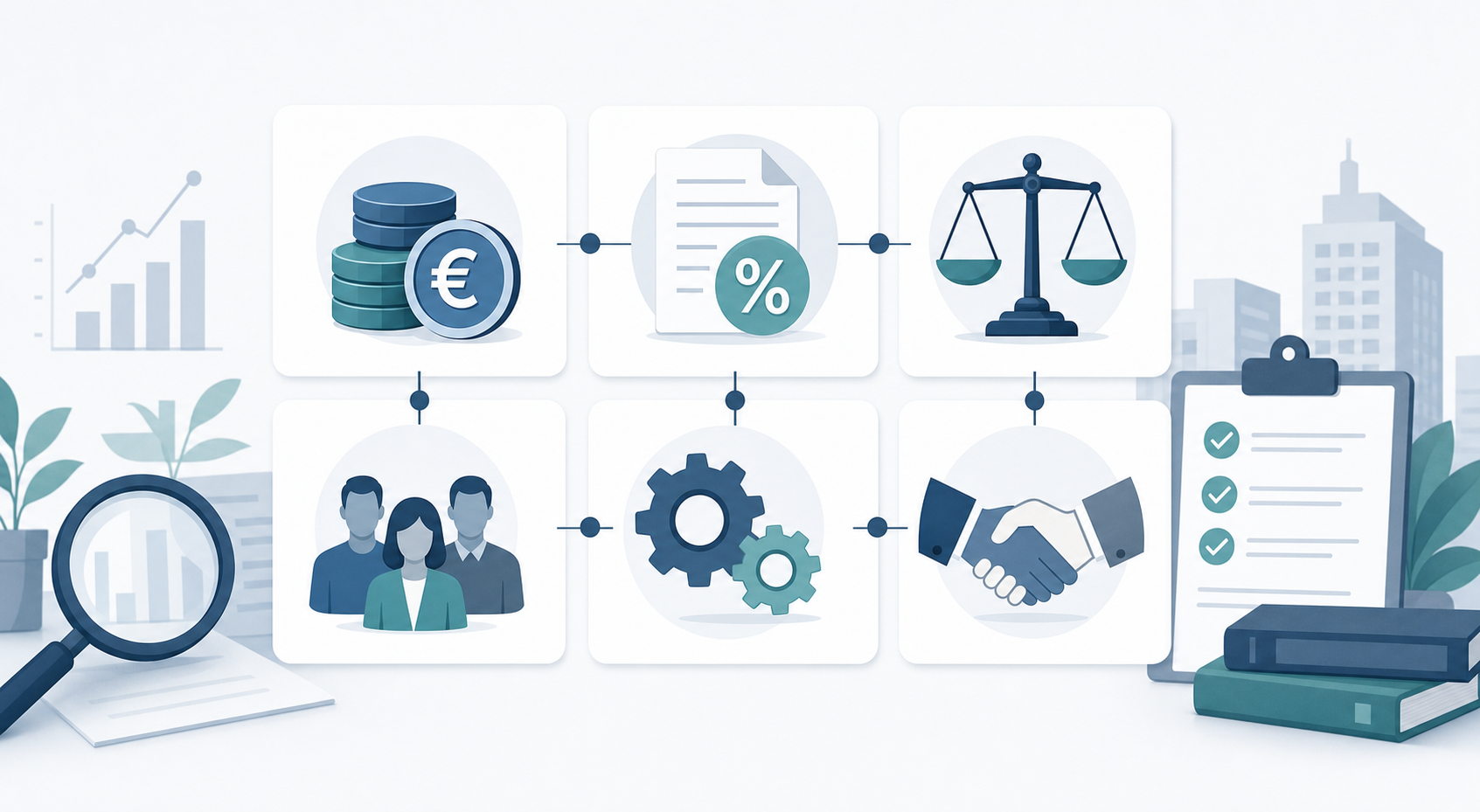
Every business has its own risks, but there are six areas that should always be analysed. Go through each one, request supporting documents, and record in writing what you find — it is this record that will support the negotiation and the contract.
1. Financial and accounting
This is the starting point: it confirms whether the business actually earns what it claims to earn and whether profitability is sustainable.
Financial statements for the last 3 to 5 years (balance sheet and income statement).
Cash flow and revenue seasonality throughout the year.
Margins by product or service and their evolution over time.
Debts, loans, leases, and guarantees provided.
Accounts receivable (age and risk of uncollectibles) and accounts payable.
Dependence on a few customers or suppliers in billing.
Coherence between accounting, bank statements, and tax returns.
This review should be read alongside the necessary analysis to evaluate the value of a business: the numbers validated here are the basis of the price that makes sense to pay.
2. Tax
Tax debts and contingencies can transfer to the business, especially when buying the company. Confirm the situation with the support of an accountant or auditor.
Regularised situation with the Tax Authority and Social Security.
VAT, corporate tax, and withholdings submitted and paid.
Any ongoing tax processes, inspections, or debts.
Tax benefits used and the obligations associated with their maintenance.
3. Legal and corporate
This confirms who owns what and what commitments the company has assumed — including clauses that may be triggered with the change of ownership.
Updated permanent certificate and corporate structure.
Articles of association, minutes, and any shareholder agreements.
Contracts with customers, suppliers, and partners (and change of control clauses).
Licences, permits, and authorisations necessary for the activity.
Litigations or ongoing or potential legal proceedings.
4. Labour
Labour due diligence assesses commitments to employees and the liabilities that accompany them — one of the most underestimated areas by first-time buyers.
Employment contracts, categories, and seniority of employees.
Salaries, bonuses, and obligations with Social Security.
Liabilities with personnel (vacation and bonuses due, potential indemnities).
Dependence on key employees and risk of departure after the sale.
5. Operational
This measures whether the business operates without the current owner and the condition of the means that generate revenue.
Internal processes, critical suppliers, and supply chain.
Condition of equipment, stock, and facilities.
IT systems, software licenses, and data management.
Dependence on the current owner in day-to-day operations.
6. Commercial, customers, and intangible assets
The value of many businesses lies in the customer portfolio and the brand — assets that can only be confirmed by looking at the data.
Customer concentration and retention or recurrence rate.
Lease agreement and conditions of the space (if applicable).
Brand, domain, social media, and online reputation.
Trademarks, patents, and copyrights duly registered.
Common mistakes to avoid
Relying solely on the seller’s verbal information without supporting documents.
Focusing only on finances and ignoring labour, tax, and legal aspects.
Underestimating the business’s dependence on the current owner.
Not formalising in writing what was promised during negotiation.
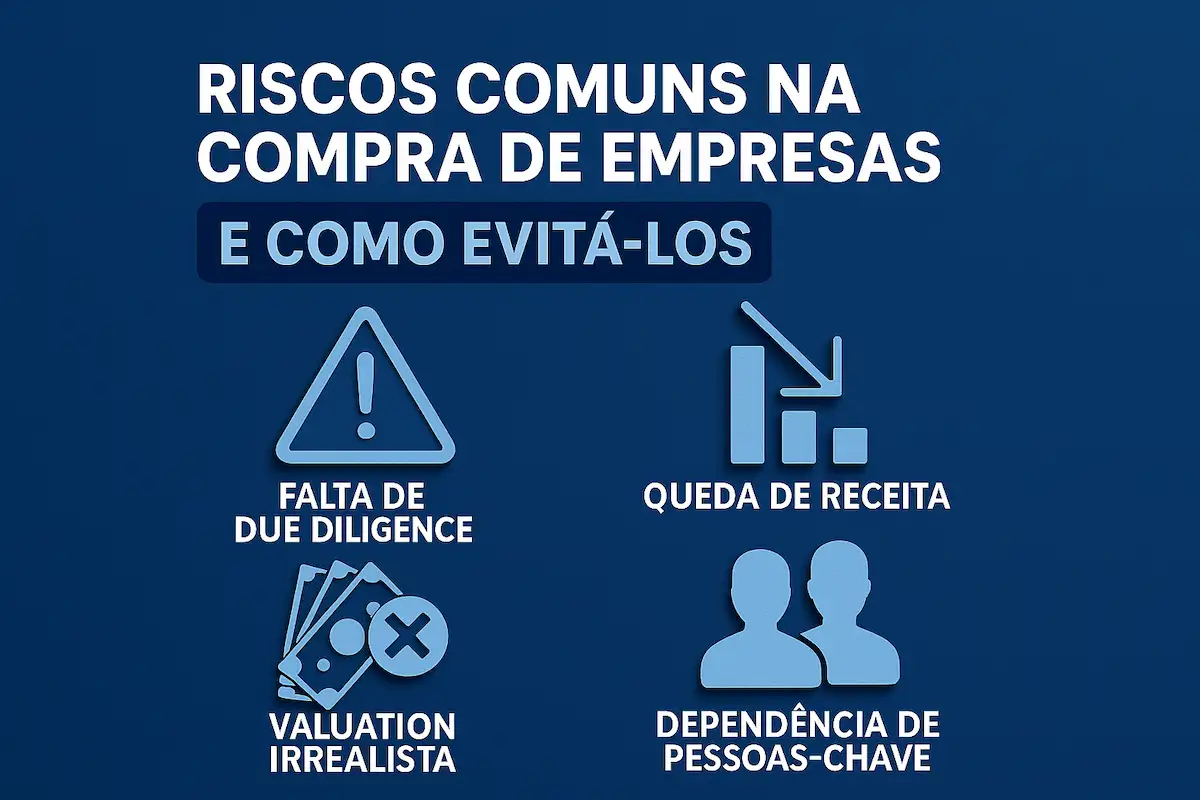
A well-conducted due diligence helps reduce the common risks in buying businesses and how to avoid them.
Who to involve and how long it takes
A well-conducted due diligence typically involves an accountant or auditor and a lawyer, and may also include specialised consultants in the sector. The timeframe varies with the size and complexity of the business — from a few weeks to several months. The cost depends on the scope and the professionals involved; request a quote based on the areas you want to cover. Although it represents an initial investment, it is usually much lower than the cost of inheriting a liability that was not detected in time.
And after due diligence?
The conclusions serve to renegotiate (price, guarantees, and conditions), to demand representations and warranties in the contract that protect you from hidden liabilities, or — as a last resort — to withdraw from the deal if the risks are unmanageable. Due diligence is not a formality: it is what separates a good purchase from an expensive problem.
Frequently asked questions about due diligence
What is due diligence in buying a business?
It is the auditing process that the buyer conducts on the business before purchasing, to verify its financial, tax, legal, labour, and operational situation. It serves to confirm the seller’s information, identify risks, and underpin the price and conditions of the purchase.
What does a labour due diligence include?
Labour due diligence analyses employment contracts, categories and seniority of employees, salaries and obligations with Social Security, liabilities with personnel (such as vacation and bonuses due or potential indemnities), and dependence on key employees who may leave after the sale.
How long does due diligence take?
It depends on the size and complexity of the business. In a small and well-organised company, it may take a few weeks; in larger businesses or those with missing documentation, it may extend for several months. The more complete the information provided by the seller, the faster the process runs.
Who should conduct due diligence?
It is usually conducted by the buyer with the support of an accountant or auditor (financial and tax area) and a lawyer (legal and corporate area), and may include specialised consultants in the sector. For any tax, legal, or accounting decision, always validate with qualified professionals.
Is it worth proceeding if due diligence finds problems?
Finding problems does not mean withdrawing. Often, the conclusions serve to renegotiate the price, demand contractual guarantees, or share responsibilities. You should only withdraw when the identified risks are unmanageable or the seller does not want to reflect them in the business.
Next step
Are you evaluating businesses to buy? Explore the businesses for sale on ComprarEmpresa.pt and apply this checklist to each opportunity before proceeding.
Official sources and resources
- Permanent commercial registration certificate — Justiça.gov.pt
- Commercial registration documents — Justiça.gov.pt
- Tax debt clearance certificate — Autoridade Tributária e Aduaneira
- Social Security contribution status certificate — Segurança Social
- Central Register of Beneficial Ownership — Justiça.gov.pt
- IP Scan — intellectual property assessment — INPI